

 Português pt
 Español es
 العربية ar
 বাংলা bn
 Deutsch de
 Filipino fil
 Français fr
 हिन्दी hi
 Bahasa Indonesia id
 Italiano it
 Русский ru
 Svenska sv
 ไทย th
 Türkçe tr
 Tiếng Việt vi
 简体中文 zh
Updated:
Options5 Options Strategies for Beginners, With Real Examples
 Naomi TanakaEditorial character · Analysis Desk

Quick answer
The five options strategies best suited for beginners are buying a call, buying a put, the covered call, the protective put and the straddle. The three that only involve buying options have a maximum loss equal to the premium paid. In all of them, besides getting the price direction right, you also need to get the timing until expiration right.
Options attract beginners because they let you take part in a big move while paying little upfront. What few people mention is that losing 100% of the amount paid is a common outcome, and that getting the direction right isn't enough: you also need to get the timing right. The five structures below go from the simplest to the one that demands the most attention.
To ground the math in something real, we used Apple's actual daily closes (AAPL, Yahoo Finance) between May and October 2026. The option premiums in the examples are hypothetical values, chosen only for the calculation; the real price of an option depends on volatility, time to expiration and interest rates on the day.
What an option is
An option is a contract that grants a right. Whoever buys a call has the right to buy the asset at an agreed price, the strike, until expiration. Whoever buys a put has the right to sell at the strike. For that right, the buyer pays a premium to the seller. Each contract usually represents 100 shares.

How to calculate an option's payoff at expiration
- Call: value at expiration = stock price − strike, if positive; otherwise, zero.
- Put: value at expiration = strike − stock price, if positive; otherwise, zero.
- Buyer's result = value at expiration − premium paid. The maximum loss is the premium.
Real example: Apple between May and October 2026
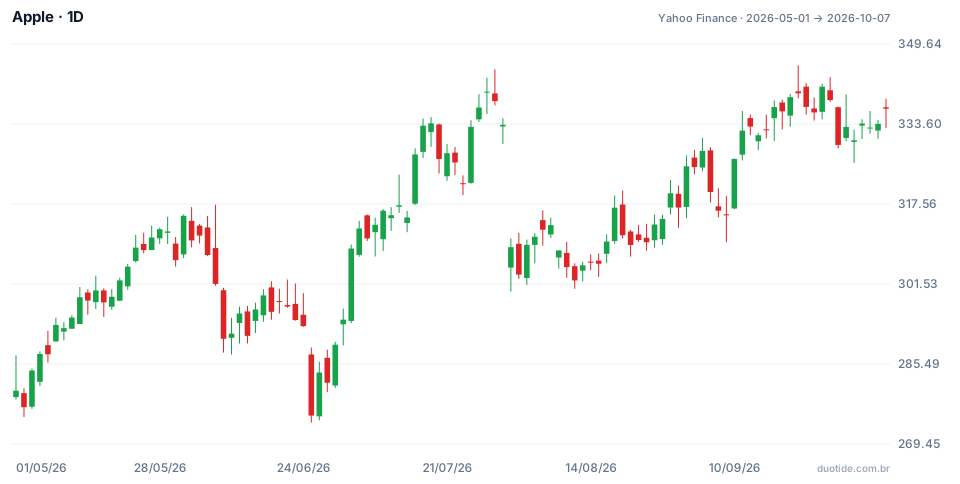
AAPL closed at $280.14 on May 1, 2026 and at $336.67 on October 7, up 20.2%. Along the way, it fell to a low of $273.75 on June 25 and rose to a high of $345.34 on September 22. It's a good scenario to show that the same stock can reward or punish each strategy, depending on the timing. In every case below, we treat the final date as if it were the expiration.

The 5 options strategies
1. Buying a call: upside with limited loss
On May 1, with the stock at $280.14, suppose you buy a call with a $290 strike for a hypothetical premium of $5.00 ($500 per contract). On June 1, AAPL closed at $306.31. The call would be worth 306.31 − 290 = $16.31, and the profit would be 16.31 − 5.00 = $11.31 per share, or $1,131 per contract, 226% on the premium. If the stock had stayed below $290, the loss would be the full $500, and nothing more than that.
2. Buying a put: protection or a bet on a drop
On June 8, with the stock at $301.54, suppose a put with a $295 strike for $5.00. On June 25, AAPL closed at $275.15, and the put would be worth 295 − 275.15 = $19.85. But if expiration had been a month after the purchase, July 8, the stock would already be at $313.39, above the strike, and the put would expire worthless: a 100% loss of the premium. The direction was right for two weeks; the timing wasn't.
3. Covered call: income on shares you already own
Someone holding 100 shares bought at $313.39 (July 8) sells a call with a $330 strike for $4.00. On August 5, the stock closed at $311.00, below the strike. The call expires worthless, the seller keeps the $4.00, and the result is −2.39 + 4.00 = $1.61 per share. The cost shows up on the upside: on July 29, AAPL closed at $338.19. With expiration on that day, the gain would be capped at 330 − 313.39 + 4.00 = $20.61 per share, versus $24.80 for someone who only held the stock.
4. Protective put: insurance with a set price
Someone who bought the stock at $338.19 on July 29 buys a put with a $325 strike for $6.00. On August 26, AAPL closed at $313.45: without protection, the loss would be $24.74 per share (7.3%). With the put, the maximum loss is capped at 338.19 − 325 + 6.00 = $19.19, no matter how much further the stock falls. If the stock rises, the put loses value and the $6.00 works as the cost of the insurance.
5. Straddle: a bet on the size of the move
On June 15, with the stock at $296.42, suppose you buy a call and a put with a $295 strike, at $7.00 each ($14.00 total). The straddle only turns a profit if the stock goes above $309 or falls below $281 at expiration. On July 15, AAPL closed at $327.50: the call would be worth $32.50, the put zero, and the profit would be 32.50 − 14.00 = $18.50 per share. If the stock had stayed near $295, the loss would be almost the entire premium on both legs.
How to use the options strategies
Start from the known maximum loss
Buying a call, buying a put and the protective put all have risk limited to the premium paid. They're the most suitable for beginners, as long as the premium is a small fraction of your capital.
The covered call requires owning the stock
The covered call is only covered because you own the shares. Selling a call without holding the asset is a different strategy, with theoretically unlimited risk, and it isn't for beginners.
Time works against the buyer
An option loses value as expiration approaches, even with the stock standing still. That's why the put example failed: the move came, but it ended before expiration.
Limitations
The examples use the payoff at expiration and hypothetical premiums. In practice, the premium rises when the market expects more volatility, liquidity on many series is low, and the bid-ask spread can be wide. The cases describe what happened with AAPL in this period, not what's going to happen.
Common mistakes with options
- Buying deeply out-of-the-money options just because they're cheap: the odds of them going to zero are higher.
- Choosing an expiration too short for the expected move.
- Risking a large share of your capital on premiums just because the maximum loss is known.
- Selling options without owning the asset or the margin to cover the worst-case scenario.
- Ignoring a series' liquidity and being unable to exit at the expected price.
- Setting up a straddle before an event without realizing the premium already prices in the expected move.
Before trading with real money, build each of these structures on a demo account or in a spreadsheet, with real premiums from the day, and track them through to expiration. Write down what you expected and what happened: it's the cheapest way to understand how time and volatility move the outcome.
Practice before you risk. Open your Duotide account and test your ideas on the demo account with US$10,000 in virtual funds.
Create free accountUpdated:
Editorial character of the Duotide newsroom. Articles are written by the team with the help of artificial intelligence; prices and charts come from real market data. Explains charts, indicators and trading strategies: how they work, where they fail and how to test them first.
Was this article helpful?
Be the first to rate it.
Comments
- No comments yet. Be the first to comment.
Ready to put it into practice?
Open your account and practice on the demo account with US$10,000 in virtual funds, without risking money.
- Secure platformProtected login and identity verification
- Multilingual supportHelp available every day
- Free demo accountUS$10,000 virtual to practice
Trading involves the risk of losing the capital invested.
