

 Português pt
 Español es
 العربية ar
 বাংলা bn
 Deutsch de
 Filipino fil
 Français fr
 हिन्दी hi
 Bahasa Indonesia id
 Italiano it
 Русский ru
 Svenska sv
 ไทย th
 Türkçe tr
 Tiếng Việt vi
 简体中文 zh
Updated:
ETFs & indicesETF or Mutual Fund: What's the Difference in Practice
 Rafael AzevedoEditorial character · Markets Desk

Quick answer
An ETF and a mutual fund both pool money from many investors into a basket of assets, but the ETF trades on an exchange during the session, at the current price, while a traditional fund has a single share price calculated at the end of the day. Index ETFs tend to have lower fees because they're passive; active funds charge more because they have a manager trying to beat the market. Neither one eliminates the risk of loss.
Anyone researching where to invest quickly finds ETFs and traditional mutual funds side by side in comparisons. Both do, at their core, the same thing: they pool money from many investors to buy a basket of assets, such as stocks, bonds, or commodities.
The difference lies in how you buy and sell the share, how much that costs over the years, and how tax is charged. In this guide we use real daily quotes for BOVA11, the ETF that tracks the Ibovespa, between April and October 2026, to show the most visible difference: the price during the trading session.
What an ETF is and what a traditional fund is
An ETF is an index fund with shares traded on an exchange. You buy and sell during the session, at that moment's price, just like with a stock. In most cases it passively tracks an index, with no manager picking assets.
A traditional fund (open-end fund) takes in deposits and redemptions directly through the administrator. The share price is calculated once a day, after the close, by dividing the fund's assets by the number of shares. It can be passive or, more often, active, with a manager trying to beat a benchmark index.

How to calculate the weight of the cost
The management fee is charged every year on the fund's assets, whether the fund gains or loses. To see the effect, suppose R$ 100,000 invested for 10 years with a hypothetical gross return of 10% a year:
- Fee of 0.1% a year: R$ 256,792.14 at the end of the period
- Fee of 1% a year: R$ 234,573.42
- Fee of 2% a year: R$ 211,927.64
The difference between 0.1% and 2% a year adds up to almost R$ 45,000 over ten years, in cost alone. That's why the fee matters more than it seems when you only look at a single year. An active fund only justifies a higher fee if the manager delivers, after costs, more than the index.
Real example: BOVA11 in October 2026
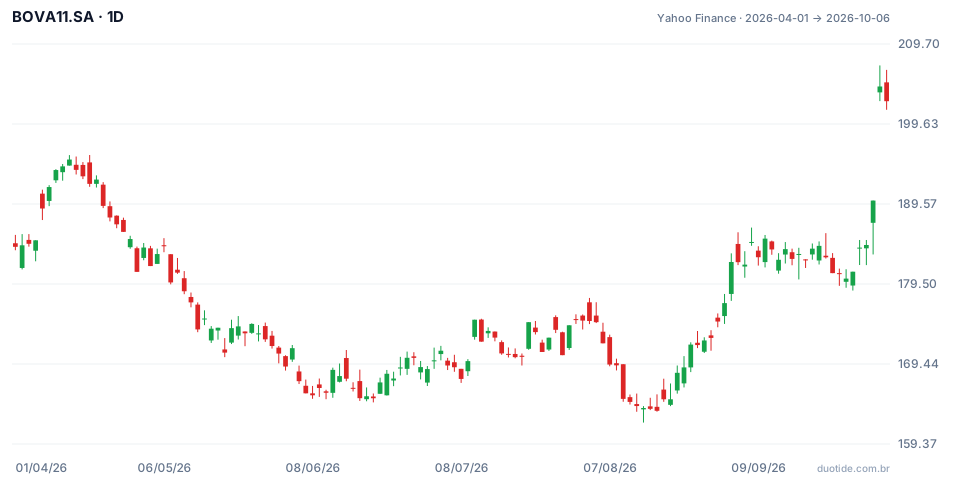
The chart shows BOVA11 from April 1, 2026 (R$184.18) to October 6, 2026 (R$202.50), a 9.95% gain. The period's low was R$162.07 on August 14, and the high, R$207.00 on October 5. Two moments show the difference between the two structures.
October 5: a day of moving prices
BOVA11 closed October 2 at R$190.00. On October 5 it opened at R$203.61, swung between R$202.51 and R$207.00, and closed at R$204.35, up 7.6% from the previous session. A 2.2% gap between the day's low and high. Anyone holding the ETF could sell at any moment, with a limit order at whatever price they wanted. A shareholder in a traditional fund who requested a redemption that day would receive the closing share value, without choosing the moment, and in many stock funds the money only lands in the account a few days later.
The ETF against the index
Between April 1 and October 6, BOVA11 rose 9.95% and the Ibovespa 9.51%. In daily data from public sources, the gap between the two is small, and part of it comes from the time each quote is recorded, not from management. The point is that a passive ETF delivers, by design, something very close to the index, both up and down: on August 14 it closed 11.0% below the April 1 price, right along with the market.
How to use each one
Trading and liquidity
With the ETF you use limit orders, stops, and follow the price in real time. With a traditional fund, deposits and redemptions follow deadlines set in the fund's rules, and the price is only known after the close.
Costs
Broad index ETFs tend to have low fees, because management is passive. Active funds charge more and, sometimes, a performance fee. On the ETF, add brokerage, if any, and the spread between bid and ask.
Tax
Under the general rules in effect in Brazil as of this review, gains from selling a stock ETF are taxed at 15%, without the exemption for sales up to R$20,000 that applies to stocks, and the investor themselves calculates and pays the tax. In open-end stock funds, tax is withheld at redemption by the administrator; fixed-income and multimarket funds also have come-cotas, a semiannual advance withholding. Check the current rules before deciding, because the law changes.
For short-term trading
For short-term strategies, only the ETF works: open-end funds have settlement periods that prevent entering and exiting on the same day, and some charge an early-exit fee. For someone contributing every month and holding for years, the discipline of investing regularly and the total cost matter more than the ability to trade during the session.
Limitations
Neither structure eliminates market risk: if the portfolio's assets fall, the share falls. Niche ETFs can have low liquidity and wide spreads. Active funds depend on the manager's decisions, which can lag the index for years.
Common mistakes when choosing between an ETF and a fund
- Looking only at past returns and ignoring the management fee.
- Forgetting to calculate and pay the tax when selling the ETF.
- Buying an active fund that, after costs, just tracks the index.
- Choosing a low-volume ETF and paying a wide spread on every entry and exit.
- Thinking either structure protects against market drops.
- Treating the examples above as a forecast: they describe what happened to BOVA11.
To practice without risking money, follow an index ETF on a demo account for a few weeks and log, each day, the open, low, high, and close. Comparing those numbers with the single share price a traditional fund would have shows, in practice, what trading during the session means.
Practice before you risk. Open your Duotide account and test your ideas on the demo account with US$10,000 in virtual funds.
Create free accountUpdated:
Editorial character of the Duotide newsroom. Articles are written by the team with the help of artificial intelligence; prices and charts come from real market data. Follows the news that moves prices — rates, stock markets, companies and commodities — explained without jargon.
Was this article helpful?
Be the first to rate it.
Comments
- No comments yet. Be the first to comment.
Ready to put it into practice?
Open your account and practice on the demo account with US$10,000 in virtual funds, without risking money.
- Secure platformProtected login and identity verification
- Multilingual supportHelp available every day
- Free demo accountUS$10,000 virtual to practice
Trading involves the risk of losing the capital invested.
