

 Português pt
 Español es
 العربية ar
 বাংলা bn
 Deutsch de
 Filipino fil
 Français fr
 हिन्दी hi
 Bahasa Indonesia id
 Italiano it
 Русский ru
 Svenska sv
 ไทย th
 Türkçe tr
 Tiếng Việt vi
 简体中文 zh
Updated:
StrategiesHedging in Trading: What It Is and How to Protect a Position
 Naomi TanakaEditorial character · Analysis Desk

Quick answer
Hedging means opening a second position that gains when the main one loses, to limit the damage if the market moves against you. It works like insurance: it reduces the loss in the bad scenario, but it also reduces the gain in the good scenario, by the same proportion. It makes sense when the criteria for using it are set before the trade, not as a reaction to a loss.
Hedge is a word that comes up constantly in finance and tends to be treated as something only big funds do. The logic, though, is simple: instead of letting the whole result depend on a single direction, you open a second position that gains when the first one loses. The goal isn't to profit twice, it's to limit the damage when your read on the market turns out wrong.
In this guide we use real daily quotes for the US dollar against the Brazilian real (USD/BRL) between May and October 2026, including the dollar's 4.3% drop on October 6, to show how much a hedge protects and how much it costs.
What hedging is
A hedge is a protective position: a second trade, in the same asset or in one that moves in a similar way, set up to offset part of the loss on the main trade. It works like insurance. You pay for it, either in profit you give up or in trading costs, and in exchange you reduce the worst possible outcome.
There are two common ways to set up this protection:
- Simultaneous hedge: both legs are opened together, usually because there's an event ahead (a rate decision, an inflation reading) and you want to reduce exposure without closing the position entirely.
- Adjustment hedge: the second position is opened after the first one is already moving against you, to lock in the maximum loss if price keeps going the same way.

How to calculate a hedge's result
The math is always the same: the main position's result plus the protective position's result, in each scenario. The protected proportion (the hedge size divided by the main position's size) is what determines how much of the loss and how much of the gain get cut.
Real example: the dollar against the real in October 2026
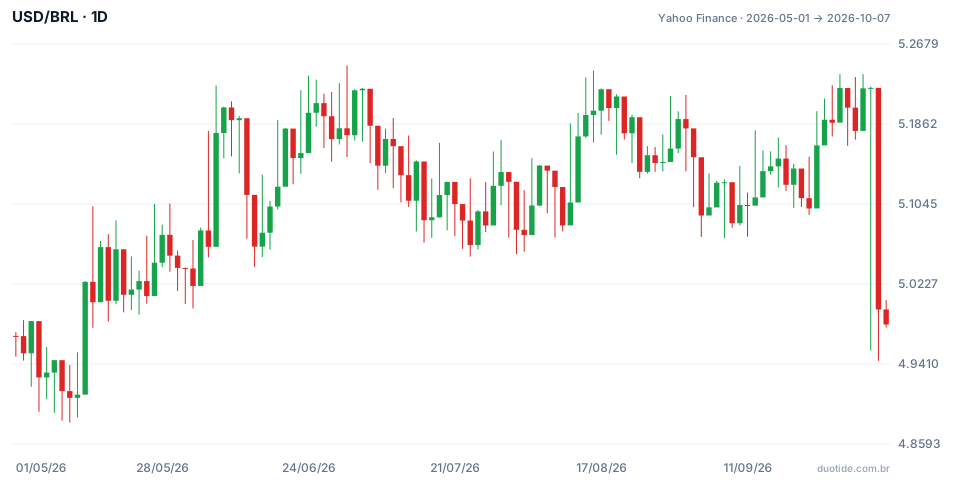
The chart shows USD/BRL from May 1, 2026 (R$4.97) to October 7, 2026 (R$4.98). For most of the period the dollar traded between R$4.88 (the low on May 12) and R$5.25 (the high on July 1). Two real situations show both sides of a hedge.
The October 6 drop: the hedge protecting
Suppose a long position of US$10,000 opened at the October 2 close, at R$5.2226. On October 6 the dollar closed at R$4.9967, a drop of R$0.2259 per dollar.
- Without a hedge: 10,000 × −0.2259 = −R$2,259.00
- With a 50% hedge (a short of US$5,000 opened at the same price): the long loses R$2,259.00 and the short gains 5,000 × 0.2259 = R$1,129.50
- Result with the hedge: −R$1,129.50, half the loss
The late-September rally: the hedge charging its price
Now the opposite scenario. From September 23 (R$5.0999) to September 29 (R$5.2229) the dollar rose R$0.1230. The same US$10,000 long position would have gained R$1,230.00. With the US$5,000 short as protection, the short would lose R$615.00 and the result would drop to R$615.00. That's the cost of the insurance: the hedge cuts the loss and the gain in the same proportion.
Notice one detail: with both legs in the same asset and at the same price, a 50% hedge gives exactly the same result as simply trading US$5,000 from the start, but paying entry and exit costs on both legs. That's why many professionals simply reduce position size instead, when the protection is in the same asset.
Fixed-return trades
In short-term trades with a fixed return, the math changes because the loss is the full amount and the gain is a percentage. With R$200 on the dollar rising and an 85% return, hedged with R$100 on the dollar falling at the same return: if the dollar rises, the first trade pays R$170 and the second loses R$100, a net result of +R$70; if the dollar falls, the first trade loses R$200 and the second pays R$85, a net result of −R$115. Compared to losing the full R$200, the hedge cut the loss by R$85 but also cut the gain from R$170 to R$70. Since the return is less than 100%, both legs together always cost more than they pay out if they're the same size.

How to use a hedge
Ahead of a known event
When there's an important release coming up and you don't want to close the position entirely, partial protection softens the shock. Decide the proportion before the event, not during it.
To lock in a maximum loss
In an adjustment hedge, the second position freezes the loss from that point on. The honest question to ask is whether it wouldn't be simpler, and cheaper, to just close the trade.
With correlated assets
It's also possible to protect a position with a different asset that tends to move together with it, like using an index to hedge a stock portfolio. The protection stays imperfect, because correlation changes over time, and the hedge can fail on exactly the day it's needed most.
Limitations
A hedge doesn't eliminate risk: it redistributes the outcome across scenarios. Each leg carries spread costs and, in some markets, position-holding costs. And a hedge opened by reflex, every time a trade starts going badly, is often just a way of postponing the decision to accept the loss.
Common mistakes when hedging
- Opening the protection in the heat of the moment, with no criteria set before the entry.
- Forgetting that a hedge cuts the gain by the same proportion it cuts the loss.
- Hedging in the same asset and paying double costs for a result equal to a smaller position.
- In fixed-return trades, opening opposite legs of the same size, which guarantees a net loss.
- Relying on a correlation between assets without checking whether it has held up in recent months.
- Treating the examples above as predictions: they describe what happened with the dollar on those specific dates.
To practice without risking money, set up a position with and without protection on a demo account, and write down, for each scenario (a small rally, a big rally, a small drop, a big drop), the net result of each version. Logging those numbers for a few weeks shows whether the insurance you're paying for actually makes sense for your plan.
Practice before you risk. Open your Duotide account and test your ideas on the demo account with US$10,000 in virtual funds.
Create free accountUpdated:
Editorial character of the Duotide newsroom. Articles are written by the team with the help of artificial intelligence; prices and charts come from real market data. Explains charts, indicators and trading strategies: how they work, where they fail and how to test them first.
Was this article helpful?
Be the first to rate it.
Comments
- No comments yet. Be the first to comment.
Ready to put it into practice?
Open your account and practice on the demo account with US$10,000 in virtual funds, without risking money.
- Secure platformProtected login and identity verification
- Multilingual supportHelp available every day
- Free demo accountUS$10,000 virtual to practice
Trading involves the risk of losing the capital invested.
