

 Português pt
 Español es
 العربية ar
 বাংলা bn
 Deutsch de
 Filipino fil
 Français fr
 हिन्दी hi
 Bahasa Indonesia id
 Italiano it
 Русский ru
 Svenska sv
 ไทย th
 Türkçe tr
 Tiếng Việt vi
 简体中文 zh
Updated:
OptionsOptions for Beginners: Premium, Strike, Exercise, and Expiration
 Naomi TanakaEditorial character · Analysis Desk

Quick answer
An option gives the buyer the right, but not the obligation, to buy (call) or sell (put) an asset at a fixed price, the strike, by the expiration date. For that right, the buyer pays a premium to the seller. The buyer risks at most the premium; the seller receives the premium and takes on the obligation to fulfill the contract.
Before any options strategy, it's worth mastering the four elements of every contract: the right it grants, the strike price, the expiration date, and the premium paid for that right. Strategies with names like bull spread, butterfly, or straddle are just combinations of these elements.
In this guide we use real daily prices for BOVA11, the index fund that tracks the Ibovespa, between April and October 2026. BOVA11's prices are real; the options' strikes and premiums are hypothetical, chosen to show the math.
What an option is
A call option gives the buyer the right, but not the obligation, to buy the underlying asset at the strike on or by the expiration date. A put option gives the right to sell under the same terms. Whoever sells the option, the writer, receives the premium and takes on the obligation on the other side: if the call buyer exercises, the writer has to sell at the strike, even if the market is well above it.
In, at, and out of the money
- In-the-money call: the asset's price above the strike.
- At the money: the asset's price equal to, or very close to, the strike.
- Out-of-the-money call: the asset's price below the strike; the option only has time value.
- Put: the logic flips; it's in the money when the asset is below the strike.

How to calculate an option's value
The premium has two parts:
- Call intrinsic value = asset price − strike (if positive; otherwise, zero).
- Put intrinsic value = strike − asset price (if positive; otherwise, zero).
- Extrinsic value (or time value) = premium − intrinsic value.
- Call breakeven at expiration = strike + premium paid.
Example with BOVA11's real price
On August 21, 2026, BOVA11 closed at R$168.33. A hypothetical call with a R$160.00 strike costing R$10.00 would have an intrinsic value of 168.33 − 160.00 = R$8.33 and an extrinsic value of 10.00 − 8.33 = R$1.67. A call with a R$170.00 strike, on the other hand, would be out of the money: intrinsic value zero, and the entire premium would be time value.
Real example: a BOVA11 call and put through expiration
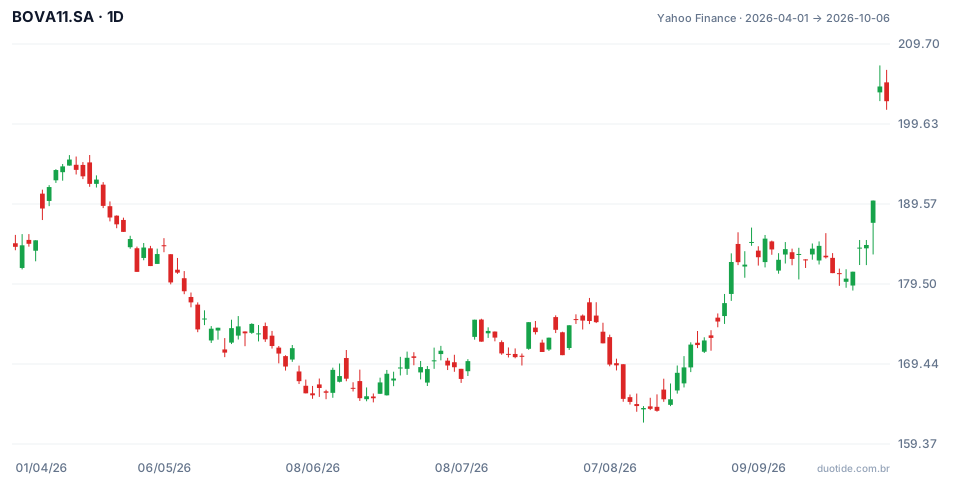
The chart shows BOVA11's daily candles from April 1, 2026, to October 6, 2026, the last session available. The fund started the period at R$184.18, fell to a low of R$162.07 on August 14, rose to a high of R$207.00 on October 5, and closed October 6 at R$202.50.
The R$170.00-strike call
Suppose a purchase, on August 21, of a call with a R$170.00 strike expiring on September 18, 2026, for a R$3.00 premium. The breakeven at expiration is 170.00 + 3.00 = R$173.00. On September 18 BOVA11 closed at R$182.47, up 8.4% from entry.
- Intrinsic value at expiration: 182.47 − 170.00 = R$12.47
- Buyer's result: 12.47 − 3.00 = R$9.47 per share, or R$947.00 on 100 shares
- Return on the premium: 9.47 ÷ 3.00 = 315.7%
- Naked writer's result: −R$9.47 per share, or −R$947.00 on 100 shares, after having received R$300.00
The R$165.00-strike put
On the same date, a R$165.00-strike put bought for R$2.50 would be betting on a drop below R$162.50. With BOVA11 at R$182.47 at expiration, the put ended out of the money and expired worthless: the buyer would lose the R$2.50 per share, R$250.00 on 100 shares, and the writer would keep the entire premium.
The same move in the asset produced a gain for one side and a total loss of the premium for the other. These numbers describe what happened to the price over that stretch; they don't indicate what will happen on other expirations.

How to use these fundamentals
Understand what happens at expiration
If the call ends in the money, the buyer normally exercises or the position is settled for the difference, depending on the market's rules. If it ends out of the money, it expires worthless and the buyer loses the entire premium. That's the maximum risk for a buyer: never more than the premium, but with a real chance of losing all of it.
Compare the buyer's risk and the seller's risk
A buyer's loss is capped at the premium. A naked seller receives the premium upfront but takes on a risk that can be much larger than it, as the R$170.00 call showed. That's why naked selling requires collateral and is usually considered riskier.
Respect time
Extrinsic value doesn't fall in a straight line: it accelerates near expiration. An option with 60 days left loses time value more slowly than the same option with 10 days left, even with the asset standing still.
Limitations
In practice, premiums change every minute and depend on implied volatility, interest rates, and each series' liquidity. Thinly traded series can have a wide spread, which makes entering and exiting before expiration more expensive.
Common mistakes for options beginners
- Forgetting that a call's breakeven is strike plus premium, not just the strike.
- Buying deeply out-of-the-money options because they look cheap.
- Selling options naked without calculating the loss in a strong move.
- Ignoring how time decay accelerates in the final weeks.
- Trading illiquid series without looking at the spread.
To practice, pick an asset on a demo account, note the strike, premium, and expiration of a call and a put, and track the intrinsic value, the extrinsic value, and the buyer's and seller's results through to the end. Logging a few complete series fixes the fundamentals better than any reading.
Practice before you risk. Open your Duotide account and test your ideas on the demo account with US$10,000 in virtual funds.
Create free accountUpdated:
Editorial character of the Duotide newsroom. Articles are written by the team with the help of artificial intelligence; prices and charts come from real market data. Explains charts, indicators and trading strategies: how they work, where they fail and how to test them first.
Was this article helpful?
Be the first to rate it.
Comments
- No comments yet. Be the first to comment.
Ready to put it into practice?
Open your account and practice on the demo account with US$10,000 in virtual funds, without risking money.
- Secure platformProtected login and identity verification
- Multilingual supportHelp available every day
- Free demo accountUS$10,000 virtual to practice
Trading involves the risk of losing the capital invested.
