

 Português pt
 Español es
 العربية ar
 বাংলা bn
 Deutsch de
 Filipino fil
 Français fr
 हिन्दी hi
 Bahasa Indonesia id
 Italiano it
 Русский ru
 Svenska sv
 ไทย th
 Türkçe tr
 Tiếng Việt vi
 简体中文 zh
Updated:
OptionsHow to Hedge a Portfolio Using Options: Puts in Practice
 Naomi TanakaEditorial character · Analysis Desk

Quick answer
To hedge a portfolio with options, the most common way is to buy puts on the stock you hold: they guarantee the right to sell at the strike until expiry. The premium paid is the cost of the insurance and defines, along with the strike, the maximum possible loss. The hedge doesn't eliminate the loss: it limits its size, covers only the contracted period, and costs money even when the decline never comes.
A hedge is any trade made to reduce the risk of another position you already hold, not to generate profit on its own. In the options market, the most common hedge for anyone holding stock is the protective put: insurance with a known price against declines in the asset.
In this guide, the price path is real: we use daily quotes for Nvidia stock (NVDA) between April and October 2026. The option premiums are illustrative, because an option's actual price depends on implied volatility and time to expiry on the day you buy it. The goal is to show the mechanics using a market move that actually happened.
What a protective put is
A put gives the buyer the right to sell the asset at a fixed price, the strike, until expiry. Anyone holding 500 shares who buys puts for 500 shares guarantees that, until that date, they can sell each share at the strike, no matter how far the price falls. In exchange, they pay a premium, which is the cost of the insurance and isn't returned.

How to calculate the hedge's cost and maximum loss
Three calculations sum up the protection:
- Insurance cost = premium × number of shares protected.
- Maximum loss = (current price − strike) × quantity + insurance cost.
- Put value at expiry = strike − stock price, if positive; otherwise, zero.
Example with Nvidia on May 14, 2026
A portfolio holds 500 Nvidia shares. On May 14 the stock closed at US$235.74, so the position was worth US$117,870. The owner doesn't want to sell, but fears a decline over the following two months.
- Buys puts for 500 shares, strike of US$220, expiring July 17, 2026, with an illustrative premium of US$6.00 per share.
- Insurance cost: 500 × 6.00 = US$3,000, or 2.5% of the position.
- Maximum loss until expiry: (235.74 − 220) × 500 + 3,000 = 7,870 + 3,000 = US$10,870, or 9.2% of the position.
Real example: the hedge on Nvidia in 2026
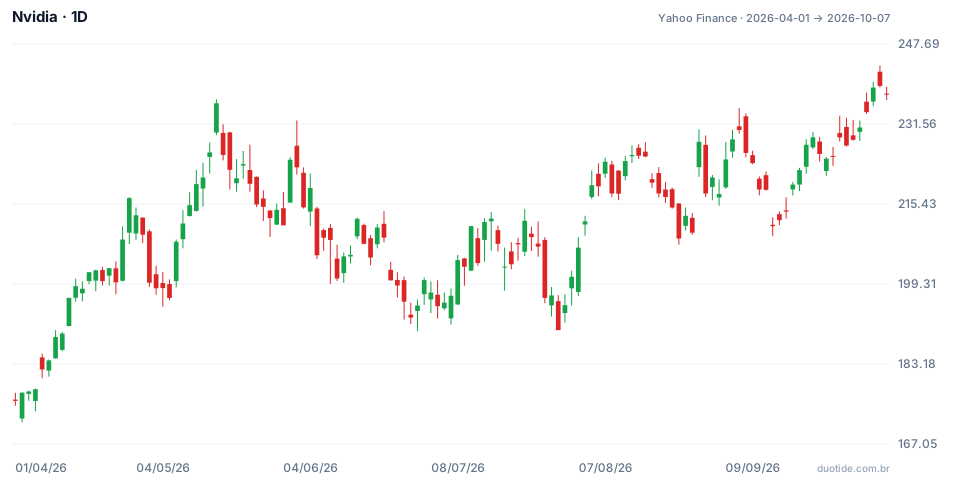
The chart shows Nvidia from April to October 2026. The stock rose from US$175.75 to US$237.47 over the period, but had a significant decline along the way. Three moments show what the hedge does and doesn't do:
May to July: the insurance that paid off
At expiry, on July 17, Nvidia closed at US$202.81. The shares lost 500 × (235.74 − 202.81) = US$16,465. Each put was worth 220 − 202.81 = 17.19, or US$8,595 in total. Result for the hedged portfolio: −16,465 + 8,595 − 3,000 = −US$10,870, exactly the maximum loss calculated in May. Without the hedge, the loss would have been 14.0% of the position; with it, 9.2%.
July: the decline after expiry
The protection ended on July 17, but the decline didn't: on July 29 the stock closed at US$190.01, 19.4% below May 14. Anyone who didn't renew the protection was exposed to that part of the move. The hedge only covers the period you paid for.
August to September: the insurance that went unused
Suppose a new hedge on August 21, with the stock at US$214.72: puts with a strike of US$200, expiring September 18, with an illustrative premium of US$5.00, costing US$2,500. At expiry Nvidia was at US$222.27, the puts expired worthless, and the shares gained 500 × 7.55 = US$3,775. Result: 3,775 − 2,500 = US$1,275, much less than without the protection. That's the cost of insurance that never gets used. These are past facts and hypothetical premiums, not a forecast.

How to use options to protect a portfolio
Choose the strike by the loss you accept
A strike closer to the current price protects sooner, but costs more. A farther strike is cheaper, but you absorb the decline down to it on your own. The right question is: how much of the position am I willing to lose before the insurance starts paying out?
Match the expiry to the risk you're worried about
If the worry is an earnings release three weeks out, an expiry shortly after it is enough. Longer terms cost more, and, as the July example showed, no term covers what happens after expiry.
Protect only part of the position
Buying puts for half the shares cuts the cost in half, and the payout on a decline too. It's a common middle ground for anyone who wants to soften the worst case without paying for the full insurance.
Finance part of the insurance
A variation is selling a call with a strike above the current price to pay for part of the put, building what's called a collar. The cost drops, but the upside gets capped at the strike of the call you sold.
Limitations
Options can have thin liquidity at distant strikes and expiries, with a wide gap between the buy and sell price. The premium rises when the market gets nervous, exactly when the protection seems most needed. And hedging all the time can eat up a large part of the portfolio's return over the years.
Common mistakes when hedging a portfolio with options
- Forgetting that the premium is a certain cost, while the payout depends on the decline actually happening.
- Choosing an expiry too short and ending up unprotected when the decline continues.
- Buying puts for a different quantity than the position without realizing it.
- Hedging all the time, at any premium, without comparing the cost with the risk.
- Confusing a hedge with a bet on a decline and buying more puts than the position calls for.
To practice without risking money, set up a position in a demo account or spreadsheet for a stock you follow, simulate buying puts at two different strikes, and log, through expiry, how much each protection cost and how much it paid out. That log shows in practice how much the insurance is worth to you.
Practice before you risk. Open your Duotide account and test your ideas on the demo account with US$10,000 in virtual funds.
Create free accountUpdated:
Editorial character of the Duotide newsroom. Articles are written by the team with the help of artificial intelligence; prices and charts come from real market data. Explains charts, indicators and trading strategies: how they work, where they fail and how to test them first.
Was this article helpful?
Be the first to rate it.
Comments
- No comments yet. Be the first to comment.
Ready to put it into practice?
Open your account and practice on the demo account with US$10,000 in virtual funds, without risking money.
- Secure platformProtected login and identity verification
- Multilingual supportHelp available every day
- Free demo accountUS$10,000 virtual to practice
Trading involves the risk of losing the capital invested.
