

 Português pt
 Español es
 العربية ar
 বাংলা bn
 Deutsch de
 Filipino fil
 Français fr
 हिन्दी hi
 Bahasa Indonesia id
 Italiano it
 Русский ru
 Svenska sv
 ไทย th
 Türkçe tr
 Tiếng Việt vi
 简体中文 zh
Updated:
MarketsHow Futures Contracts Work: Margin and Daily Settlement
 Rafael AzevedoEditorial character · Markets Desk
Quick answer
A futures contract is a standardized agreement, traded on an exchange, to buy or sell an asset on a future date at a price fixed today. Traders deposit an initial margin and, every day, receive or pay the difference between the day's settlement price and the previous day's. This daily settlement makes the gain or loss show up in cash immediately, not only at expiration.
Futures contracts were born out of the need for grain producers and buyers to lock in a price before harvest. The mechanism worked so well that today there are futures on stock indices, currencies, interest rates, oil, and metals, traded on exchanges such as B3 in Brazil and the CME in the United States.
In this guide we explain the pieces of the contract and run the daily settlement math using real quotes from the gold futures contract (GC, continuous series from Yahoo Finance) from April to October 2026, a period in which gold fell nearly 14%.
What a futures contract is
A futures contract is a standardized agreement to buy or sell a defined quantity of an asset, on a future date, at a price agreed today. The exchange defines everything except the price: contract size, expiration date, settlement method, and minimum tick size. The only thing participants negotiate is the price.
- Long: whoever buys the contract gains if the price rises.
- Short: whoever sells gains if the price falls, even without owning the asset.
- Standardized size: the CME gold contract, for example, equals 100 troy ounces; every US$ 1 move in the ounce's price is worth US$ 100 per contract.
- Clearinghouse: the exchange sits between buyer and seller and guarantees payment on both sides.
Who uses them, and for what
There are two main groups. The hedger wants protection: a mining company that sells gold futures locks in the price of its production; an importer that buys dollar futures locks in the exchange rate. The speculator wants to profit from the price move and, by doing so, takes on the risk the hedger wants to pass along. Both are needed for the market to have liquidity.

How to calculate margin and daily settlement
To open a position, the exchange requires an initial margin, a fraction of the contract's value deposited as collateral. It isn't the price paid: it's the deposit that covers the losses of one or two bad days.
The second piece is daily settlement. At the end of every session the exchange compares the day's settlement price with the previous day's. Whoever gained receives the difference in cash; whoever lost pays it. The position doesn't build up a hidden loss until expiration: it's charged day by day.
The settlement formula is: (today's price − yesterday's price) × contract size × number of contracts. For those who are short, the sign flips.
Real example: gold futures in 2026
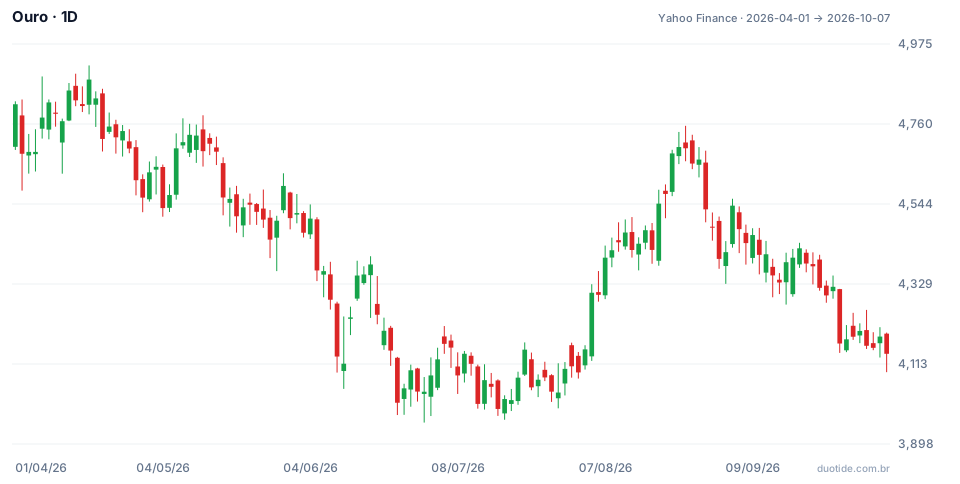
The chart shows gold futures from April 1, 2026, at US$ 4,813.10 an ounce, to October 7, 2026, at US$ 4,140.70. A drop of 13.97% over the period. The high was US$ 4,917.70, on April 17, and the low was US$ 3,955.40, on June 30. We use daily closes as a proxy for the settlement price.
A week of settlements, step by step
Suppose you buy 1 contract (100 ounces) at the close on April 17, at US$ 4,879.60. The contract's value is 4,879.60 × 100 = US$ 487,960. Over the following days:
- April 20: closed at 4,828.80 → (4,828.80 − 4,879.60) × 100 = −US$ 5,080
- April 21: closed at 4,719.60 → (−109.20) × 100 = −US$ 10,920
- April 22: closed at 4,753.00 → (+33.40) × 100 = +US$ 3,340
- April 23: closed at 4,724.00 → (−29.00) × 100 = −US$ 2,900
- April 24: closed at 4,740.90 → (+16.90) × 100 = +US$ 1,690
Week's total: −5,080 − 10,920 + 3,340 − 2,900 + 1,690 = −US$ 13,870, exactly (4,740.90 − 4,879.60) × 100. The result is the same as if it were calculated only at the end; the difference is that it comes out of your cash day by day. If the deposited margin falls below the required minimum, the broker asks for more, the so-called margin call, or closes the position.
June 10: the worst day
On June 10 gold fell 3.57%, from US$ 4,286.40 to US$ 4,133.30. For every contract bought, that single day's settlement was −153.10 × 100 = −US$ 15,310. It's for days like this that margin exists.
The same period seen from the short side
A mining company that had sold 1 contract on April 1, at US$ 4,813.10, and held it until October 7, at US$ 4,140.70, would have received in settlements (4,813.10 − 4,140.70) × 100 = US$ 67,240. That gain offsets the drop in the price of the physical gold it sells: that's the hedge at work. If gold had risen instead, it would have paid settlements, but sold its production at a higher price.

How to use futures contracts
For protection (hedging)
Anyone with real exposure to a price, such as a producer, an importer, or an investor with a stock portfolio, can use futures to lock in that price. The goal isn't to profit from the contract, but to make the outcome predictable.
For speculation
Anyone trading to profit from the price move should size the position by the possible loss, not by the margin. In gold, a single day in 2026 moved US$ 15,310 per contract. Mini contracts, like the CME's 10-ounce contract or B3's mini index and mini dollar, exist precisely to allow smaller exposures.
Expiration and rollover
Every contract has an expiration date. Anyone who wants to keep the position needs to close out the expiring contract and open the next one, the rollover, which has a cost and can involve a price difference between expirations.
Limitations
The example uses Yahoo Finance's continuous series, which strings together different expirations, and daily closes in place of the official settlement price. Margin amounts change depending on the exchange and volatility. The numbers describe what happened, not what will happen.
Common mistakes with futures contracts
- Confusing margin with price: the risk is on the full value of the contract, nearly US$ 488,000 in the example.
- Not keeping free cash for daily settlements and getting closed out on a margin call.
- Forgetting about expiration and rollover.
- Trading full-size contracts when the account's size calls for mini contracts.
- Thinking that hedging is meant to generate a profit: it's meant to lock in a price, in both directions.
To lock in how the mechanism works, open a contract on a demo account and record, at the end of every day, the settlement price and the amount credited or debited. After a week or two of logging it, the logic of daily settlement becomes clear in a way no explanation can replace.
Practice before you risk. Open your Duotide account and test your ideas on the demo account with US$10,000 in virtual funds.
Create free accountUpdated:
Editorial character of the Duotide newsroom. Articles are written by the team with the help of artificial intelligence; prices and charts come from real market data. Follows the news that moves prices — rates, stock markets, companies and commodities — explained without jargon.
Was this article helpful?
Be the first to rate it.
Comments
- No comments yet. Be the first to comment.
Ready to put it into practice?
Open your account and practice on the demo account with US$10,000 in virtual funds, without risking money.
- Secure platformProtected login and identity verification
- Multilingual supportHelp available every day
- Free demo accountUS$10,000 virtual to practice
Trading involves the risk of losing the capital invested.
