

 Português pt
 Español es
 العربية ar
 বাংলা bn
 Deutsch de
 Filipino fil
 Français fr
 हिन्दी hi
 Bahasa Indonesia id
 Italiano it
 Русский ru
 Svenska sv
 ไทย th
 Türkçe tr
 Tiếng Việt vi
 简体中文 zh
Updated:
ForexSwap Rate (Overnight): How to Calculate the Cost of a Position
 Naomi TanakaEditorial character · Analysis Desk

Quick answer
The swap rate is the cost, or credit, charged for holding a leveraged position open overnight. It's calculated by multiplying the position value by the annual rate and dividing by 360, or by multiplying the number of lots by the swap per lot, then by the number of nights. On one day of the week the charge is usually tripled, to cover the weekend.
Every leveraged position that stays open past the trading day's rollover time can generate a cost, or sometimes a credit, called swap, overnight rate, or rollover. It shows up in forex, CFDs on stocks, indices and commodities, and in margin positions in cryptocurrencies. If the trade is opened and closed before the rollover time, there's usually no swap.
The problem with the swap is that it doesn't show up at the time of entry. It gets charged later, night after night, and a lot of people only notice the weight of it when a trade meant to last hours turns into a position held for weeks. In this guide we do the math with the real EUR/USD quote (from Yahoo Finance) and compare the result with how much the pair typically moves in a day.
What the swap rate is
Anyone trading leveraged controls a position larger than the money deposited. The difference is, in practice, financed. In forex, the swap reflects the interest rate difference between the pair's two currencies, plus the margin charged by the platform. In CFDs, it reflects the position's financing cost. That's why buying and selling the same asset carry different swaps, and one side can even receive instead of pay.
Two things change from one platform to another: how the rate is shown (annual percentage, points, or value per lot) and the day the rollover is charged in triple to cover the weekend. In forex, that day is usually Wednesday, but always check the instrument's conditions.

How to calculate the swap
There are two formulas, depending on how the rate is shown on the platform:
- Annual rate as a percentage: swap per night = position value × annual rate ÷ 360 (or 365, depending on the instrument).
- Value per lot: swap per night = number of lots × swap per lot.
- Total: swap per night × nights charged, counting the triple night when the position runs through it.
Example with the real EUR/USD quote
The last close of EUR/USD in the series used here was 1.12535. A standard EUR/USD lot equals 100,000 euros, so the position value is 100,000 × 1.12535 = US$ 112,535. The rates below are hypothetical, just to show the math; real ones vary by platform and change with interest rates.
- Financing rate of 2.5% a year on the long side: 112,535 × 0.025 ÷ 360 = US$ 7.81 per night (7.8149 unrounded, the value used in the calculations that follow).
- Triple night: 7.8149 × 3 = US$ 23.44.
- A full week (five rollovers, seven nights charged): 7.8149 × 7 = US$ 54.70.
- Thirty nights: US$ 234.45, the equivalent of 23.4 pips, since on a standard EUR/USD lot each pip is worth US$ 10.
Now the per-lot version. Suppose the platform shows a long swap of −US$ 6.50 per lot and a short swap of +US$ 1.80 per lot. Half a lot long held through the triple night costs 0.5 × 6.50 × 3 = US$ 9.75. Half a lot short the same night earns 0.5 × 1.80 × 3 = US$ 2.70. The sign is what matters: use exactly what the platform shows.
Real example: the swap compared with EUR/USD's move
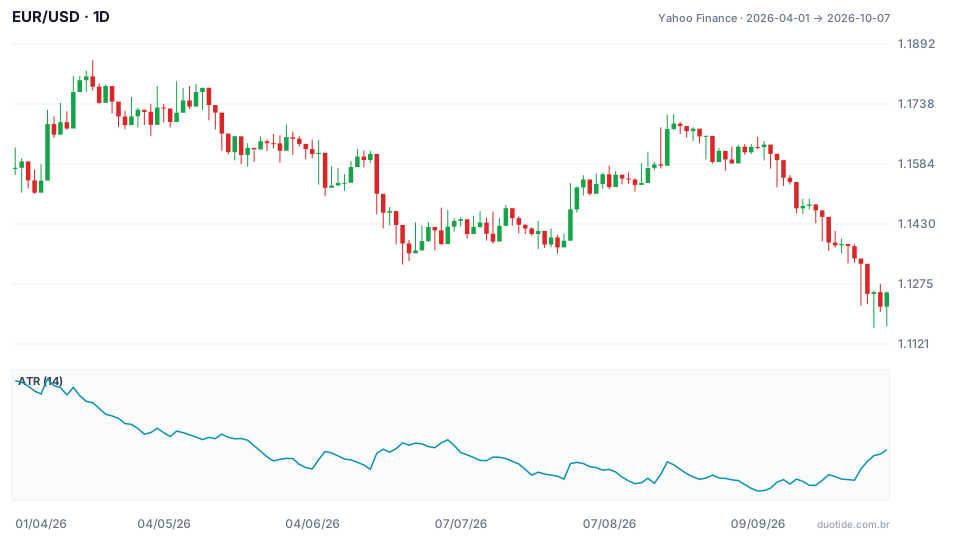
The chart shows EUR/USD from April to October 2026 with the 14-period ATR, which measures the average daily range. It works as a ruler for telling whether the swap is small or large next to how much the price usually moves.
A day's or a week's swap: small next to the ATR
At the end of the series, the ATR stood at 0.00654, or 65.4 pips. On one lot, that's about US$ 654 of average daily swing. The example's week of swap (US$ 54.70) equals 8.4% of that daily move. For anyone holding a position for a few days with a target the size of the ATR, the cost exists, but it doesn't decide the outcome.
Calm market: the same swap weighs more
The period's lowest ATR was 0.00473 (47.3 pips) on September 9, and the highest, 0.00965 (96.5 pips) on April 8. With the pair moving less, the same cost per night takes up a bigger slice of the target. For a short-term trader aiming for 10 pips (US$ 100 per lot), a single night of US$ 7.81 already eats up 7.8% of the planned gain.
A long-held position: the swap becomes a price move
Between April 1 (1.15742) and the end of the series (1.12535), EUR/USD fell 2.77%. A one-lot long held for four months, at the example's hypothetical rate, would add up to 120 × 7.8149 ≈ US$ 937.79, or 93.8 pips, nearly the highest ATR of the entire period. Over long holding periods, the swap needs to be part of the plan from the start.
How to use the swap calculation
Before holding the position overnight
Add up the expected swap for the planned number of nights and compare it with the trade's target. If the cost is a small fraction of the target, it's manageable. If it's a large slice, reduce the size, shorten the timeframe, or reconsider the trade.
As a tiebreaker
The trade's direction should come from the analysis, not from the swap. But between two similar ideas, the one with a much lower overnight cost, or a credit, is a legitimate choice.
On the triple night
A trade opened Tuesday to last two days runs through Wednesday and pays four nights, not two. Note the triple rollover day for every instrument you trade.
Limitations
The swap changes when interest rates change, and the platform can alter the rate without prior notice. The math above is an estimate; what counts is the value posted in the statement. On holidays, the night count can also change.
Common mistakes with the swap rate
- Forgetting the swap because it doesn't show up on screen at the time of entry.
- Ignoring the triple night and only counting business days.
- Using the long rate for a short position, or flipping the rate's sign.
- Choosing the trade's direction based on the swap, instead of the analysis.
- Turning a short-term trade into a position held for months without recalculating the accumulated cost.
To practice, open a small position on a demo account, let a few nights pass, including the triple one, and compare the posted swap with your own math. Log the values for every instrument you trade: within a few weeks you'll have your own table of overnight costs.
Practice before you risk. Open your Duotide account and test your ideas on the demo account with US$10,000 in virtual funds.
Create free accountUpdated:
Editorial character of the Duotide newsroom. Articles are written by the team with the help of artificial intelligence; prices and charts come from real market data. Explains charts, indicators and trading strategies: how they work, where they fail and how to test them first.
Was this article helpful?
Be the first to rate it.
Comments
- No comments yet. Be the first to comment.
Ready to put it into practice?
Open your account and practice on the demo account with US$10,000 in virtual funds, without risking money.
- Secure platformProtected login and identity verification
- Multilingual supportHelp available every day
- Free demo accountUS$10,000 virtual to practice
Trading involves the risk of losing the capital invested.
