

 Português pt
 Español es
 العربية ar
 বাংলা bn
 Deutsch de
 Filipino fil
 Français fr
 हिन्दी hi
 Bahasa Indonesia id
 Italiano it
 Русский ru
 Svenska sv
 ไทย th
 Türkçe tr
 Tiếng Việt vi
 简体中文 zh
Updated:
PsychologyDo 90% of Traders Really Lose Money? What the Data Shows
 Camila NascimentoEditorial character · Risk & Behavior Desk

Quick answer
The 90% figure doesn't come from a single study, but the data points the same way: in Brazil, 97% of people who kept day-trading the mini-index for more than 300 sessions lost money, and in Europe between 74% and 89% of retail CFD accounts lose money. The main causes are oversized risk per trade, leverage and costs.
Almost everyone who researches trading runs into the line: 90% of traders lose money. It shows up in videos, courses and conversations, almost always without a source. The exact number varies by study, but the underlying conclusion keeps repeating: among retail traders operating short-term, losing is the most common outcome.
This article looks at where those numbers come from, what they actually measure and, with an example calculated on real bitcoin prices, why position size explains a large part of the wiped-out accounts.
Where the 90% number comes from
There is no single study that measures every trader in the world. The number circulates because several surveys, done in different markets and periods, arrive at similar percentages, always within specific groups: retail traders, short-term trades and, often, leveraged products.
Brazil: day trading the mini-index
The most cited study in the country comes from researchers at FGV and USP (Chague, De-Losso and Giovannetti, 2019), who analyzed every retail trader who day-traded mini-index futures on B3 between 2013 and 2015. Among those who kept trading for more than 300 sessions, 97% lost money. Only 1.1% earned more than the equivalent of a minimum wage.
Europe: CFDs
In 2018, ESMA, the European securities regulator, reported that between 74% and 89% of retail investor accounts in CFDs (leveraged contracts on asset prices) tend to lose money. Since then, brokers regulated in the European Union have been required to show, in their ads, the percentage of retail accounts that lose money with them.
Taiwan: day traders
Studies by Barber, Lee, Liu and Odean using complete data from the Taiwan stock exchange found that fewer than 1% of day traders manage to profit consistently after costs.
In other words: the 90% figure isn't exact, but it isn't an exaggeration either. In some groups, reality is worse.
Why most traders lose
- Risking too much per trade: just a few losses in a row can already wreck the account.
- Leverage: it amplifies both gains and losses; a normal price move can wipe out the account.
- Costs: commissions, spread and taxes weigh more the more you trade.
- No tested plan: entering the market without having tested the strategy beforehand.
- Emotional decisions: raising risk to make up for losses, moving the stop, exiting winners too early.
Real example: position size in bitcoin
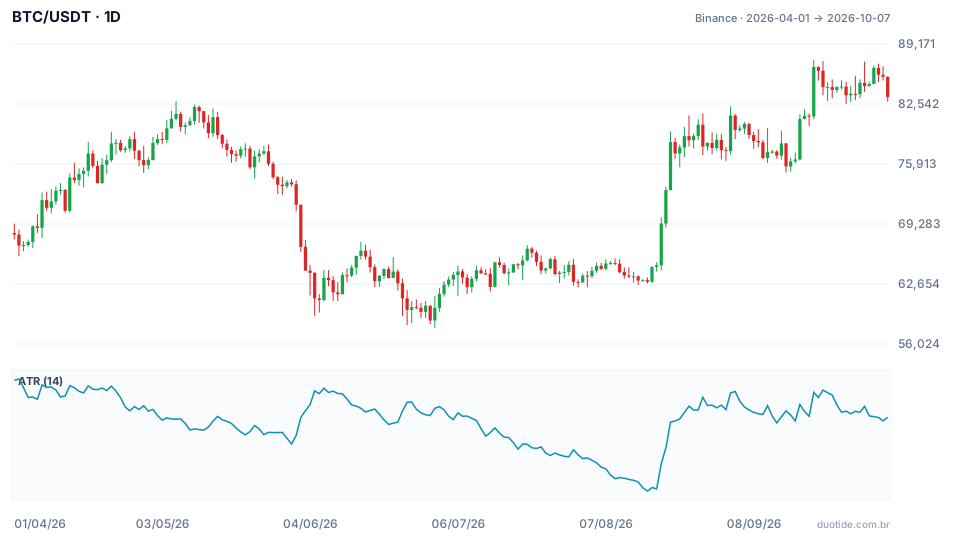
The chart shows bitcoin (BTC/USDT on Binance) from April 1 to October 7, 2026, with the 14-day ATR, which measures how much the price moves on average per day. On October 7, BTC closed at US$ 83,321.81, with an ATR of US$ 2,187.23. Let's compare two traders with the same US$ 2,000 account and the same stop, at 1.5 × ATR, or US$ 3,280.85 from the entry price.
Trader A: risks 1% per trade
- Risk: 1% of US$ 2,000 = US$ 20.
- Position: 20 ÷ 3,280.85 = 0.0061 BTC, about US$ 508 of exposure.
- After five losses in a row: 2,000 × 0.99 raised to the 5th power = US$ 1,901.98. The account dropped 4.9%.
Trader B: risks 20% per trade
- Risk: 20% of US$ 2,000 = US$ 400.
- Position: 400 ÷ 3,280.85 = 0.1219 BTC, about US$ 10,159 of exposure, more than five times the account. Only possible with leverage.
- After five losses in a row: 2,000 × 0.8 raised to the 5th power = US$ 655.36. The account dropped 67%.
What bitcoin actually did
From the high of US$ 82,850 on May 6, 2026 to the low of US$ 57,800.19 on July 1, BTC fell 30.2%. With exposure of five times the account, a 20% drop alone would have been enough to lose 100% of the capital. Trader B wouldn't have needed to get the analysis wrong five times; being long through just one of that asset's normal drops would have been enough. Volatility also shifted along the way: the ATR went from US$ 2,685.82 on April 2 to US$ 1,226.13 on August 16, and anyone who doesn't adjust position size for that is risking more than they realize.
These numbers describe what happened with bitcoin during this period, not what will happen.

How to use this statistic
As a warning, not a sentence
These studies measure the average behavior of groups. They show which mistakes are most common: poorly sized risk, leverage, overtrading. Avoiding these mistakes doesn't guarantee a profit, but it takes you out of the group that loses for avoidable reasons.
Start small and keep a record
Risk a small fraction of your capital per trade, ideally between 0.5% and 2%, and log every trade. Without a record, there's no way to know if you're improving.
Limitations
Each study covers one market, one product and one period. The Brazilian study covers mini-index day trading; the European one covers CFDs. The percentages don't automatically apply to someone investing long-term, for example. And no risk management eliminates the possibility of loss.
Common mistakes for anyone trying to stay in the 10%
- Thinking the statistic only applies to other people.
- Risking a large share of the account per trade to grow faster.
- Using leverage without calculating total exposure relative to capital.
- Raising risk after losses to try to recover.
- Overtrading and ignoring how much costs weigh.
- Starting with real money without having tested the strategy on demo.
Before risking real money, run the exercise above on a demo account: set a fixed risk per trade, calculate position size using the asset's ATR, and log every trade for a few weeks. If the demo account can't survive the rules, the real account won't survive either.
Practice before you risk. Open your Duotide account and test your ideas on the demo account with US$10,000 in virtual funds.
Create free accountUpdated:
Editorial character of the Duotide newsroom. Articles are written by the team with the help of artificial intelligence; prices and charts come from real market data. Writes about risk management, position sizing and the psychology behind traders' decisions.
Was this article helpful?
Be the first to rate it.
Comments
- No comments yet. Be the first to comment.
Ready to put it into practice?
Open your account and practice on the demo account with US$10,000 in virtual funds, without risking money.
- Secure platformProtected login and identity verification
- Multilingual supportHelp available every day
- Free demo accountUS$10,000 virtual to practice
Trading involves the risk of losing the capital invested.
